Blog / Service

Blog

All Service Colonial Cadillac Service Woburn Cadillac Dealer Woburn Cadillac Service New Inventory Tires
What Tires Fit the 2026 Cadillac Escalade

What Tires Fit the 2026 Cadillac Escalade?

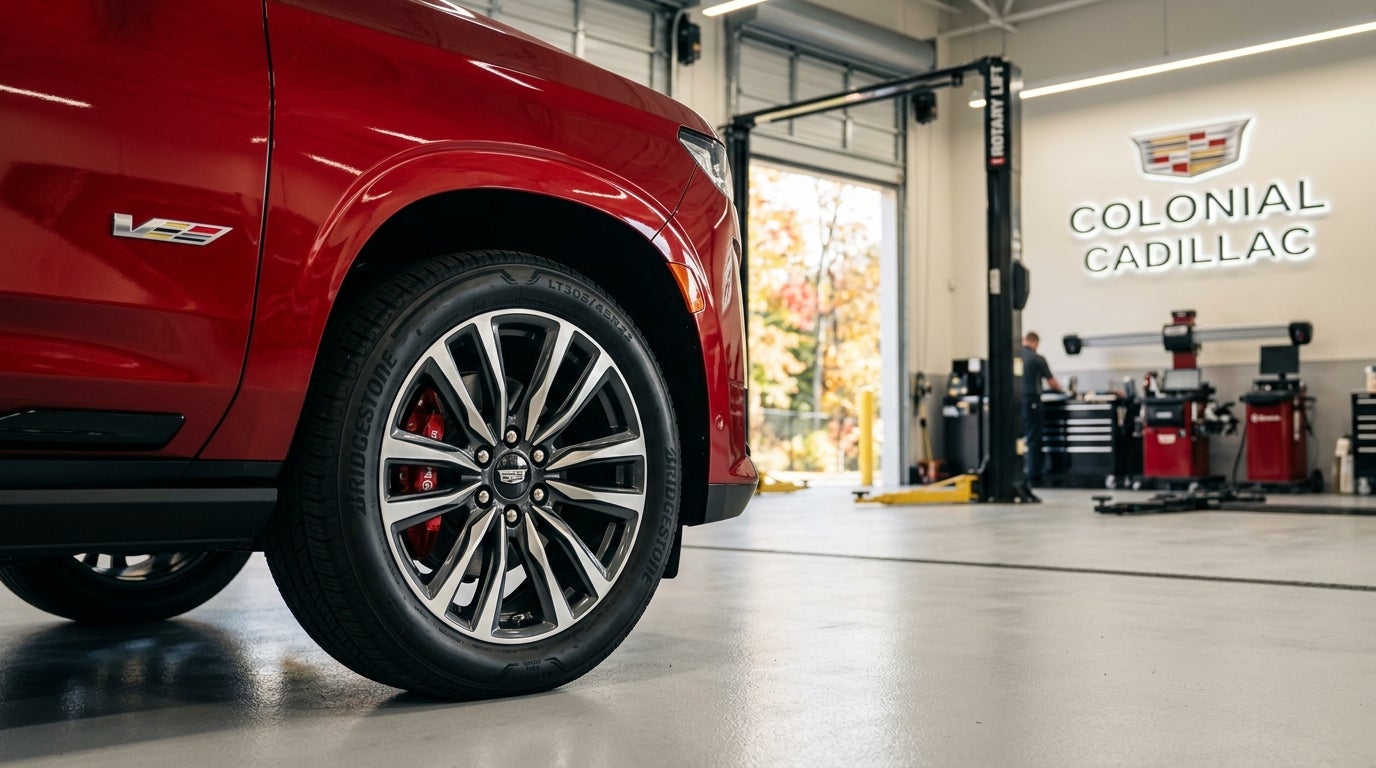
The standard tire fitment for the 2026 Cadillac Escalade is 275/50R22 on 22-inch wheels across major trims including Luxury, Premium Luxury, Premium Luxury Platinum, Sport, and Sport Platinum. Models equipped with available 24-inch factory wheel packages require 285/40R24 tires, while the factory temporary spare tire size is 265/70R17SL. All primary tire options must maintain an Extra Load rating to support vehicle weight. Understanding tire sizing nomenclature ensures correct replacement selections for full-size luxury SUVs: Section Width: The figure 275 represents the tire's width in millimeters from sidewall to sidewall. Aspect Ratio: The number 50 indicates that the sidewall height equals 50 percent of the section width. Construction: The letter R designates radial ply construction. Rim Diameter: The figure 22 specifies the rim diameter in inches. The 2026 Cadillac Escalade utilizes a 6x139.7mm (6x5.5 inches) wheel bolt pattern with a 78.1mm center bore and a positive offset between +24mm and +28mm. Maintaining exact overall tire diameter across wheel size options prevents electronic speedometer calibration drift, transmission shift timing errors, and driver-assist system disengagements. Before purchasing new tires, vehicle owners should inspect the driver-side B-pillar tire and loading information placard to verify factory specifications. To discuss tire inventory or confirm vehicle fitment with factory-trained technicians, visit our Woburn service facility or give our service department a quick call to verify current stock. Table of Contents What Are the Required Load, Speed, and UTQG Ratings for Escalade Tires? Do 22-Inch Factory Escalade Tires Handle Winter Driving and Snow in Boston? How Much Does a Full Set of Replacement Tires Cost for a Cadillac Escalade vs. Lincoln Navigator? What Do Mounting, Balancing, and Disposal Cost? Where Can You Confirm Cadillac Escalade Tire Availability and Installation? Common Questions About Cadillac Escalade Tire Service and Maintenance Schedule Cadillac Escalade Tire Service in Woburn What Are the Required Load, Speed, and UTQG Ratings for Escalade Tires? Cadillac Escalade replacement tires require an Extra Load rating with a load index of 115 or 116, supporting up to 2,756 pounds per tire, along with a minimum speed rating of H (130 mph) or V (149 mph). Factory original equipment tires carry a Uniform Tire Quality Grading treadwear rating between 500 and 640. Because the Escalade is a large, body-on-frame luxury vehicle equipped with a 6.2L V8 engine and a 10-speed automatic transmission, curb mass ranges between 5,800 and 6,000 pounds before adding passengers or cargo. Standard Load tires lack the structural sidewall reinforcement necessary to handle these high vertical and lateral forces. Fitting an Extra Load ( XL) tire ensures that structural integrity, cornering stability, and emergency braking distances remain within factory safety parameters when towing up to 8,100 pounds. Tire performance categories for full-size luxury vehicles depend heavily on standardized sidewall ratings: Load Index (115–116): Guarantees dynamic weight capacity for full passenger seating and heavy trailering. Speed Rating (H or V): Indicates continuous heat dissipation capability under sustained highway driving speeds. Treadwear Rating (500–640): Measures relative tread life expectancy under standardized test conditions. Traction Rating (AA or A): Represents wet-surface straight-line braking capability on asphalt and concrete. Temperature Rating (A): Certifies resistance to internal heat generation under heavy loads. Selecting tires that meet or exceed these parameters prevents premature tire shoulder breakdown and preserves the smooth ride characteristics associated with factory chassis tuning. Do 22-Inch Factory Escalade Tires Handle Winter Driving and Snow in Boston? Factory 275/50R22 all-season tires deliver adequate traction in light snow, but dedicated winter tires provide significantly shorter stopping distances and improved lateral grip during cold weather and heavy slush. The standard all-season rubber compound stiffens in temperatures below 45 degrees, reducing rubber flexibility and asphalt adhesion. Drivers navigating urban pavement around Boston during winter encounter road salt, packed snow, and sudden temperature drops. While all-season tread designs feature circumferential grooves to channel water and thin slush away from the contact patch, their tread blocks lack the deep siping required to bite into packed snow or icy surfaces. Furthermore, wide 275mm tread profiles tend to float over deep slush rather than cutting down to solid pavement. Installing dedicated winter tires on 22-inch wheels or downsizing to a dedicated 20-inch winter wheel-and-tire package offers distinct driving advantages: Hydrophilic Tread Compounds: Remain flexible in sub-zero conditions to maximize tire contact area. High-Density Siping: Creates thousands of microscopic biting edges that trap snow particles for snow-on-snow traction. Slush-Clearing Channels: Wide lateral shoulder grooves push dense, slushy accumulation away from the tire centerline. Vehicle owners in cold-winter regions should regularly rinse tire tread and wheel assemblies to remove road salt brine, protecting alloy rims and TPMS valve stems from oxidation. How Much Does a Full Set of Replacement Tires Cost for a Cadillac Escalade vs. Lincoln Navigator? A complete set of four replacement 22-inch tires for a 2026 Cadillac Escalade in Boston typically costs between $1,150 and $1,850 before installation fees, while high-performance 24-inch fitments range from $1,600 to $2,400. Replacement tire costs for the Lincoln Navigator fall into a virtually identical range of $1,200 to $1,800 per set due to shared standard 22-inch wheel dimensions. Comparing maintenance expenses between competing full-size luxury SUVs reveals equivalent long-term tire investment requirements: Vehicle Standard Tire Size Typical Set Cost Range (22-Inch) High-Performance Option Cost (24-Inch) Cadillac Escalade 275/50R22 $1,150 – $1,850 $1,600 – $2,400 Lincoln Navigator 285/45R22 $1,200 – $1,800 N/A Both luxury platforms utilize reinforced XL tire casings engineered for quiet operation, heavy curb mass, and high towing limits. Price variances within each model range depend primarily on brand positioning, mileage warranty lengths, and specific tread categories such as highway touring, ultra-high-performance, or dedicated winter tires. Purchasing high-grade OEM-spec replacement tires preserves factory ride isolation and dampens road noise. What Do Mounting, Balancing, and Disposal Cost? Professional tire mounting, high-speed computerized balancing, new valve stems, and tire disposal fees generally add $30 to $50 per wheel, totaling $120 to $200 for a set of four tires. Combining tire installation with a comprehensive four-wheel suspension alignment protects new tread investment against premature scrubbing. Mounting wide-aspect 22-inch or 24-inch luxury tires requires specialized tire machines equipped with touchless mounting heads to protect polished alloy wheel lips from scratches. Computerized road-force balancing places weight correctors along the inner rim to eliminate rotational high spots that cause high-speed steering wheel shimmy. Installation procedures include essential shop services: Touchless Mounting: Prevents mechanical contact between steel tools and sensitive alloy rim flanges. Dynamic Balancing: Calibrates rotational symmetry across vertical and horizontal planes. TPMS Service: Replaces rubber grommets and resets electronic dashboard monitoring systems. Environmental Disposal: Ensures compliant recycling of old casing materials. Commuters driving over the rolling residential hills around Belmont experience continuous suspension movement from varying road surfaces. Scheduling a four-wheel alignment during new tire installation ensures the chassis tracks straight and prevents uneven inner-shoulder wear. Where Can You Confirm Cadillac Escalade Tire Availability and Installation? Cadillac Escalade tire availability, factory fitments, and professional installation can be confirmed directly through our service center at Colonial Cadillac of Woburn, located at 201 Cambridge Road in Woburn. Our service facility maintains high-capacity vehicle lifts and factory calibration equipment specifically designed for full-size luxury chassis. Factory-trained service technicians perform tire replacements using GM-approved tire changers, precision balancers, and alignment software matched to advanced suspension systems like Magnetic Ride Control and electronic air leveling. Replacing tires at an authorized service facility ensures that electronic steering angle sensors and chassis control modules are zeroed to original factory parameters. Our service department maintains a broad inventory of approved 275/50R22 and 285/40R24 replacement tires matching original load indices and speed ratings. When vehicle owners bring full-size luxury SUVs in for routine inspections, our technicians evaluate tread depth profiles across all four wheels to spot subtle alignment drift before uneven wear damages a fresh tire set. Common Questions About Cadillac Escalade Tire Service and Maintenance Q: How often should Cadillac Escalade tires be rotated? Cadillac Escalade tires should be rotated every 7,500 miles or during every scheduled engine oil change. Routine tire rotations distribute front steering forces and rear torque loads evenly across all four positions, extending overall tread life and preventing irregular shoulder wear on heavy full-size SUVs. Q: Can 24-inch wheels be mounted on an Escalade that came with 22-inch tires? Yes, 24-inch wheels wrapped in 285/40R24 tires can be mounted on an Escalade originally equipped with 22-inch wheels. Because the lower-profile aspect ratio maintains equivalent overall rolling diameter, electronic speedometer calibration, odometer tracking, and transmission shift schedules remain accurate. Q: How does tire misalignment affect Super Cruise on the Cadillac Escalade? Physical suspension misalignment forces steering angle sensors to detect continuous mechanical drift while traveling straight. Because Super Cruise relies on precise steering position feedback and thrust line tracking, severe alignment drift can trigger system disengagements or restrict hands-free availability until a physical four-wheel alignment and electronic sensor calibration are completed. Q: Does the Cadillac Escalade include a full-size spare tire? The Cadillac Escalade includes a space-saver temporary spare tire sized 265/70R17SL mounted under the rear cargo floor. While designed for low-speed emergency transport to a service facility, it should be replaced with a standard 275/50R22 tire promptly to restore full load-carrying capacity and handling safety. Q: What is the recommended cold inflation pressure for 22-inch Escalade tires? The recommended cold tire inflation pressure for factory 275/50R22 tires on a Cadillac Escalade is typically 36 PSI, as stated on the driver-side door jamb tire information label. Maintaining proper cold inflation pressure prevents center-tread wear, preserves fuel efficiency, and protects rim lips from road impacts. Schedule Cadillac Escalade Tire Service in Woburn Maintaining correct tire sizing, load ratings, and inflation pressures ensures your Cadillac Escalade delivers the smooth ride, precise tracking, and towing safety designed into its chassis. Routine tire rotations paired with periodic wheel alignments protect your tire investment against premature wear caused by harsh pavement joints and seasonal road hazards. When you notice steering pull, wheel vibration, or uneven tread wear across your 22-inch or 24-inch tires, our service team is equipped to inspect, balance, align, or replace your tires with factory-approved fitments. To confirm tire availability or arrange your next service visit, get directions to our Woburn service center, reach our technicians directly by calling (781) 935-7000, or easily schedule a service appointment online today. © 2026 Colonial Cadillac of Woburn. All rights reserved.
How Often Do 2026 Cadillac Models Need Fluid Flushes

How Often Do 2026 Cadillac Models Need Fluid Flushes?

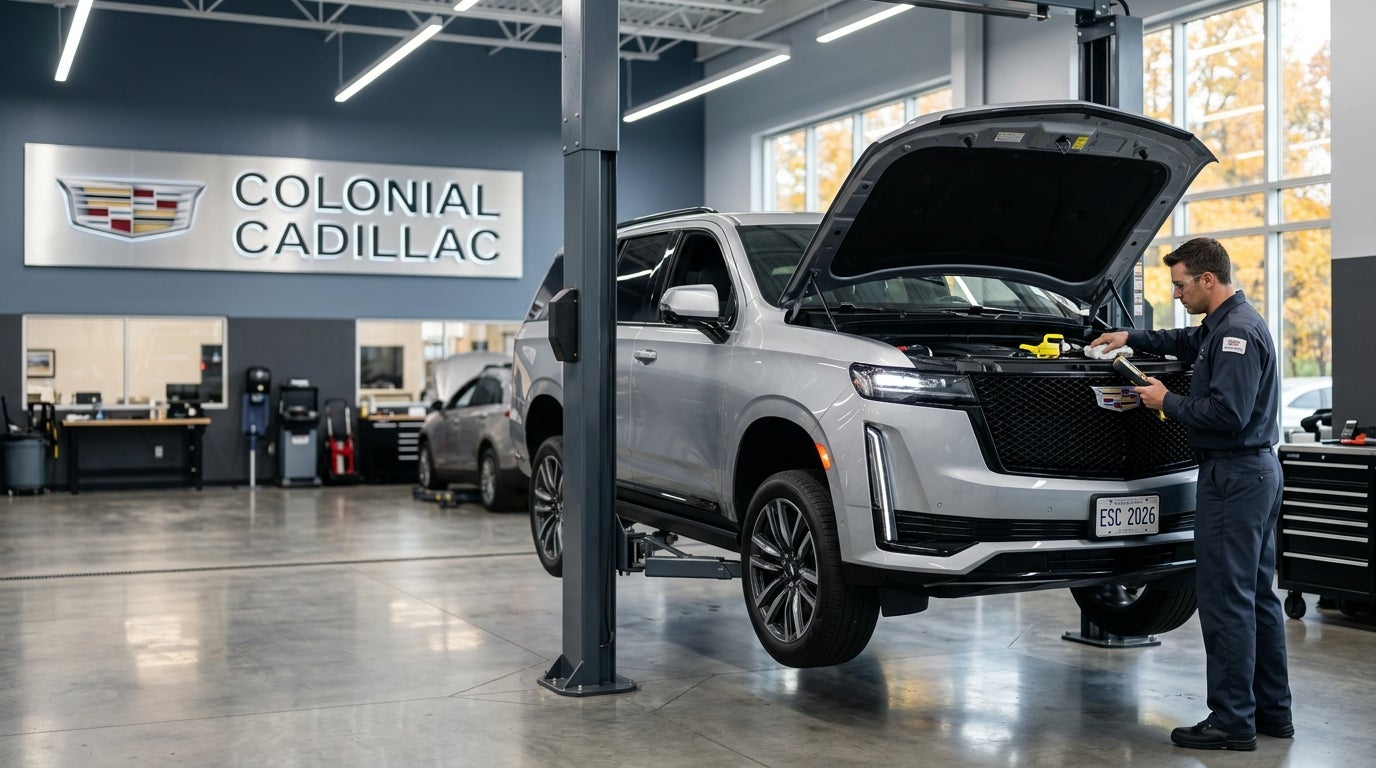
Cadillac models typically require engine oil changes every 7,500 miles, coolant flushes between 30,000 and 60,000 miles, transmission fluid service between 60,000 and 90,000 miles, and differential fluid service starting at 90,000 miles. Brake fluid requires routine inspection and service based on chemical degradation rather than fixed mileage alone. Operating under severe New England driving conditions, such as frigid winter temperatures, road salt, and frequent stop-and-go travel, accelerates these recommended maintenance intervals. Every modern Cadillac vehicle relies on specialized hydraulic and thermal fluids to protect high-precision powertrain assemblies. Engine oil neutralizes combustion byproducts while lubricating internal components, monitored continuously by the onboard Oil Life System. Coolant maintains engine operating temperature while preventing internal corrosion within the aluminum engine block and radiator core. Hydraulic brake fluid translates pedal force into mechanical stopping power, and automatic transmission fluid manages thermal loads while lubricating complex gear sets and planetary clutch packs. The routine maintenance schedule for modern Cadillac sedans and SUVs follows distinct operational windows: Engine Oil and Filter: Replaced every 7,500 miles or when triggered by the internal monitoring software. Engine Coolant (DEX-COOL): Inspected during routine visits and flushed between 30,000 and 60,000 miles depending on model specifications. Automatic Transmission Fluid: Serviced between 60,000 and 90,000 miles under standard driving schedules. Front and Rear Differential Fluid: Inspected regularly and replaced around 90,000 miles on applicable all-wheel-drive platforms. Brake Fluid: Evaluated during multi-point inspections for moisture absorption and thermal breakdown. Commuters driving from suburban communities like Belmont into urban centers often subject their vehicles to severe operating cycles. Short journeys in cold weather prevent fluids from reaching full operating temperature, allowing moisture to collect in crankcases and fluid reservoirs. Scheduling preventative inspections at our Woburn service center ensures these critical systems are tested before thermal degradation leads to mechanical wear. Drivers can also speak directly with our service desk by calling our team (781) 935-7000 to review vehicle maintenance histories. Table of Contents What Are the Signs That a Cadillac Needs an Immediate Brake Fluid Flush? When Is a Fluid Top-Up Sufficient Compared to Needing a Full Flush? What Happens If You Delay a Coolant Flush on a Cadillac Escalade or XT5? Is a Transmission Fluid Flush More Expensive on Cadillac AWD and 4WD Models? How Often Does the Battery Coolant Need to Be Flushed on a Cadillac EV? Common Questions About Cadillac Fluid Top-Ups and Flushes Schedule Official Cadillac Fluid Service Near Boston What Are the Signs That a Cadillac Needs an Immediate Brake Fluid Flush? A Cadillac requires an immediate brake fluid flush if the brake pedal feels soft or spongy, stopping distances increase unexpectedly, the fluid in the master cylinder reservoir turns dark brown or black, or an ABS warning light appears on the instrument cluster. Hydraulic brake fluid is naturally hygroscopic, meaning it continuously absorbs water moisture directly from surrounding ambient air through micro-pores in rubber brake lines. Over time, absorbed water lowers the boiling point of glycol-based DOT 4 brake fluid. During hard braking or descending steep grades, thermal energy generated at the brake rotors transfers into the calipers. If moisture content inside the fluid exceeds acceptable limits, heat turns that water into compressible steam pockets within the brake lines. This vapor lock prevents hydraulic pressure from reaching the calipers, producing a dangerously long pedal stroke. Indicator Early Stage Warning Advanced System Defect Recommended Immediate Action Pedal Feel Slight increase in travel before engagement Soft, spongy, or pedal sinks to floorboard Hydraulic line pressure test and fluid flush Fluid Appearance Clear amber turns to dark yellow Dark brown or cloudy with particulate matter Master cylinder reservoir flush and fresh fluid refill Stopping Performance Minor loss in initial pedal bite Noticeable delay in vehicle deceleration Full system flush and caliper seal inspection Dashboard Lights Intermittent stability control alerts Solid Brake System or ABS indicator light Diagnostic scan and complete brake system service Contaminated brake fluid also damages internal anti-lock braking actuators and precision valve blocks. Moisture causes internal oxidation on steel pistons within caliper bores, accelerating seal deterioration and risking expensive hydraulic component failures. Drivers experiencing any change in pedal feedback can schedule a multi-point inspection using our online service scheduler to verify fluid condition and hydraulic system integrity. When Is a Fluid Top-Up Sufficient Compared to Needing a Full Flush? A fluid top-up is sufficient when system fluid drops slightly due to minor thermal expansion or routine usage while retaining its original clarity, color, and chemical properties. A complete fluid flush is required when fluid exhibits thermal breakdown, heavy discoloration, suspended debris, or when the vehicle reaches manufacturer mileage milestones. Understanding the operational differences between these two maintenance procedures helps owners protect key mechanical assemblies: Fluid Top-Up: Involves adding fresh, factory-approved fluid directly into a reservoir to restore proper fill levels. This process corrects minor fluid loss caused by normal operation or slight evaporation without clearing out old, aged fluid from deeper hydraulic channels. Fluid Flush: Utilizes professional exchange equipment to push out old fluid from internal galleries, torque converters, lines, and heat exchangers. Fresh fluid is introduced concurrently, flushing out suspended metallic micro-particles, oxidized sludge, and degraded chemical additives. Our service advisors notice that commuters who travel along high-density traffic corridors often ask whether a quick reservoir top-up is enough after seeing a low fluid level message. Adding fresh fluid to contaminated or burnt fluid does not restore lost protective properties. Fresh oil or coolant mixed into degraded fluids quickly oxidizes, leaving vital internal gears, pumps, and engine passages exposed to friction and excess heat. What Happens If You Delay a Coolant Flush on a Cadillac Escalade or XT5? Delaying a coolant flush on a Cadillac Escalade or XT5 in Boston causes anti-corrosion additives within DEX-COOL silicate-free coolant to break down, allowing rust, scale, and organic deposits to form throughout the cooling system. As these protective compounds degrade, the engine cooling circuit transitions from an anti-corrosive state to an acidic fluid environment. Modern Cadillac V6 and V8 engines utilize multi-metal cooling circuits featuring aluminum cylinder heads, composite radiator tanks, and brass heater cores. Acidic coolant creates galvanic corrosion between these dissimilar metals. Microscopic metal debris strips off internal engine jackets and lodges inside narrow radiator tubes, restricting heat dissipation. This restricted flow elevates engine head temperatures, increasing the risk of head gasket warping or block damage. In heavy urban driving through Boston, elevated engine temperatures put excessive stress on auxiliary cooling fans, water pump bearings, and cabin heater cores. Corrosive coolant deteriorates water pump shaft seals, causing premature coolant leaks that can lead to sudden thermal loss. Replacing engine coolant at factory-specified intervals eliminates acidic buildup and preserves the heat exchanger efficiency required during summer heat waves and winter defroster operation. Is a Transmission Fluid Flush More Expensive on Cadillac AWD and 4WD Models? A transmission fluid flush on Cadillac AWD and 4WD models is generally more comprehensive than on two-wheel-drive configurations because full driveline service involves inspecting and servicing transfer cases along with front and rear differential assemblies. While standard two-wheel-drive models only require servicing a single automatic transmission fluid loop, all-wheel-drive platforms utilize multiple complex fluid reservoirs. Driveline Component Primary Lubricant Type Function in Driveline Servicing Requirement Automatic Transmission DEXRON VI / Specialized Automatic Transmission Fluid Manages gear ratios and torque converter operation Flush pan, replace filter, and exchange internal fluid Transfer Case High-Viscosity Transfer Case Fluid Transfers drive torque between front and rear axles Drain and refill fluid; inspect seals for leakage Front Differential Synthetic Gear Lubricant Drives front wheels on all-wheel-drive sedans and SUVs Inspect fluid quality; replace at specified intervals Rear Differential / Twin-Clutch Specialized Synthetic Gear Oil Handles rear torque vectoring and wheel differential Drain fluid, replace friction modifiers if equipped Modern electronic all-wheel-drive systems, such as twin-clutch rear drivelines found across luxury crossovers, rely on precise fluid viscosity to engage active clutch packs smoothly. Contaminated driveline fluid causes clutch chatter, hesitation during torque transfer, and accelerated mechanical wear across internal differential ring and pinion gears. Servicing every driveline component simultaneously ensures consistent power delivery across all four wheels. How Often Does the Battery Coolant Need to Be Flushed on a Cadillac EV? Cadillac electric vehicles require battery thermal management coolant replacement between 5 years or 75,000 miles and 150,000 miles, depending on the specific battery architecture and thermal loop design outlined in the owner's manual. Unlike internal combustion engines, electric vehicles use specialized low-conductivity coolant to maintain exact operating temperatures across large high-voltage battery arrays. The thermal management system in an electric vehicle regulates battery cell temperatures during fast-charging sessions and intense power delivery. Low-conductivity coolant circulates through cooling plates embedded beneath the battery modules, absorbing heat and venting it through front-mounted radiators. Over time, chemical breakdown can increase the electrical conductivity of the fluid or reduce its heat-transfer efficiency. Flushing battery coolant requires specialized equipment to purge air pockets completely from intricate cooling plates. Trapped air pockets create localized hot spots across individual battery cells, which can trigger thermal throttling during fast DC charging or reduce overall driving range. Adhering to manufacturer guidelines preserves battery health and ensures maximum charging speeds throughout the vehicle's lifespan. Common Questions About Cadillac Fluid Top-Ups and Flushes Q: How can a driver tell if transmission fluid is degraded before shifting issues start? Fresh automatic transmission fluid features a bright pink or red color with a clean, slightly sweet smell. As heat and friction break down the fluid over thousands of miles, it turns dark brown or black and develops a distinct burnt odor. Inspecting fluid color during routine maintenance visits catches thermal degradation before slipping gears, harsh engagement, or transmission diagnostic codes occur. Q: Does Cadillac Premium Care Maintenance cover routine fluid flushes? Cadillac Premium Care Maintenance covers factory-recommended routine maintenance services during the initial coverage period, including engine oil changes, tire rotations, and select multi-point inspections. Specialized fluid flushes, such as complete transmission or differential fluid exchanges that fall outside initial complimentary maintenance windows, are serviced as recommended owner maintenance items. Q: Can low power-steering fluid cause noise on modern Cadillac models? Many newer Cadillac vehicles utilize electric power steering systems that operate without hydraulic fluid or pumps. However, on Cadillac models equipped with hydraulic power steering systems, low fluid levels cause whining or groaning noises when turning the steering wheel. Low hydraulic fluid introduces air bubbles into the pump, leading to pump cavitation and heavy steering effort. Q: Why is matching exact fluid specifications critical for Cadillac vehicles? Modern Cadillac engines, transmissions, and differentials rely on proprietary fluid formulations like DEX-COOL and specialized synthetic gear oils engineered for specific operating clearances and seal materials. Using non-approved aftermarket fluids can damage internal seals, void manufacturer warranty coverage, degrade clutch pack performance, and lead to mechanical component failure. Q: What is included during a Cadillac multi-point fluid inspection? During a multi-point inspection, factory-trained technicians check fluid levels, inspect fluid clarity and moisture content, examine hoses and fittings for micro-cracks or weeping seals, and inspect fluid pans and housings for external leaks. This comprehensive check evaluates engine oil, engine coolant, brake fluid, windshield washer fluid, and driveline lubricants. Schedule Official Cadillac Fluid Service Near Boston Maintaining fresh hydraulic, lubrication, and thermal fluids protects engine performance and preserves long-term resale value. Delaying critical fluid flushes risks accelerated mechanical wear, reduced fuel efficiency, and expensive repairs across vital vehicle powertrains. Our factory-trained technicians utilize genuine OEM fluids, specialized fluid exchange machinery, and factory diagnostic tools to service your luxury vehicle according to exact engineering standards. Before your visit, explore our current service and parts specials for practical savings on routine vehicle maintenance. Visit our Woburn facility at 201 Cambridge Rd, Woburn, MA 01801, or get navigational directions to our service center to speak with a service advisor. You can also reserve an appointment online or contact our service department directly by calling (781) 935-7000 today. © 2026 Colonial Cadillac of Woburn. All rights reserved.

Contact Us

Fill out this form below and we'll contact you shortly
*Required Fields