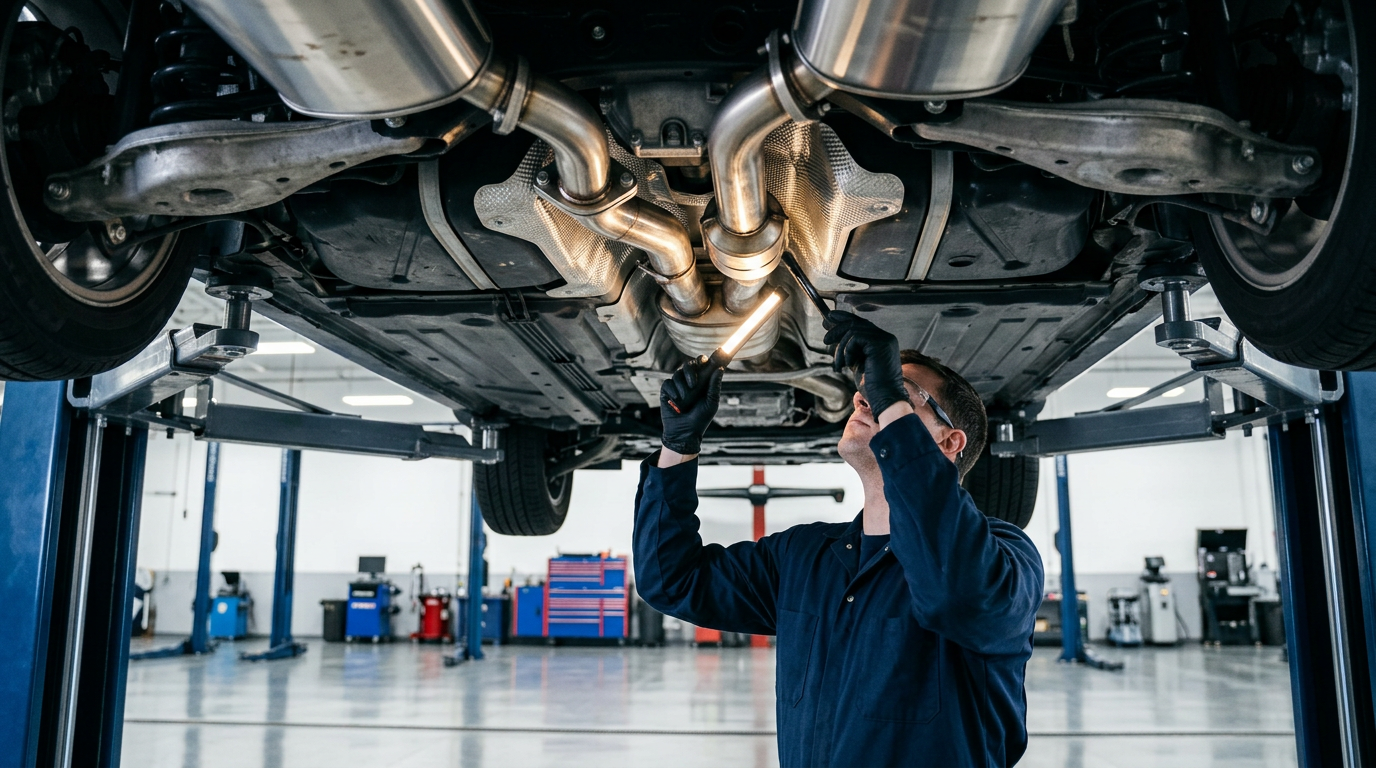
A Cadillac exhaust system requires professional repair immediately if you notice cabin exhaust odors, metallic rattling under the floorpan, a sudden deep rumble during acceleration, or an illuminated check engine light triggered by emissions codes. Prompt evaluation prevents toxic carbon monoxide exposure, protects engine performance, and ensures compliance with Massachusetts annual safety and emissions inspection standards. Delaying exhaust service can lead to damaged oxygen sensors, melted underbody shields, or premature catalytic converter failure.
The exhaust network in a modern Cadillac vehicle does far more than quiet engine combustion noises. It routes toxic gases safely away from the passenger compartment, regulates backpressure for efficient engine operation, and treats raw emissions through precision catalytic converters. When leaks, cracks, or rust compromise this sealed piping network, engine performance drops while safety risks increase.
In New England driving environments, environmental stress accelerates component wear. Road salts, moisture, and extreme temperature swings weaken metal seams, flange joints, and flexible couplings. If you suspect an exhaust leak or damage beneath your vehicle, contact (781) 935-7000 or visit our Woburn facility for a comprehensive multi-point exhaust system evaluation.
Table of Contents
- What Are the Key Signs That a Cadillac Exhaust System Needs Repair?
- How Does Cadillac Dual Active Exhaust Function on V-Series Models?
- Will a Non-CARB Catalytic Converter Pass Massachusetts Inspection?
- What Factors Cause Variation in Cadillac Exhaust Repair Costs Near Boston?
- Does Installing an Aftermarket Exhaust Void Cadillac Warranty Coverage?
- What Regular Maintenance Extends Cadillac Exhaust Lifespan?
- Common Questions About Cadillac Exhaust and Muffler Service
- Schedule Your Cadillac Exhaust Inspection in Woburn Today
What Are the Key Signs That a Cadillac Exhaust System Needs Repair?
Recognizing early warning signs of exhaust component failure prevents costly secondary engine damage and keeps your vehicle operating quietly and efficiently. An exhaust leak or failing muffler manifests through audible, visual, and performance-related symptoms that require diagnostic attention.
Our factory-trained technicians frequently evaluate vehicles exhibiting these common indicators of exhaust deterioration:
- Unusually Loud Engine Noise: A sharp ticking sound during cold starts or a deep, droning roar during acceleration indicates a crack in the exhaust manifold, a blown flange gasket, or a rusted-through muffler shell.
- Metallic Rattling Under the Chassis: Loose heat shields, broken interior baffle plates inside the muffler, or fractured rubber exhaust isolators cause persistent metallic vibration against the undercarriage.
- Exhaust Odors Inside the Cabin: A sweet sulfur smell or raw exhaust fumes inside the vehicle signals a leak upstream of the tailpipe, posing an immediate health hazard to occupants.
- Sluggish Acceleration and Poor Fuel Economy: Leaks near the engine disrupt backpressure and distort air-fuel ratio readings captured by the upstream oxygen sensors, forcing the engine management computer to overcompensate with excessive fuel delivery.
- Visible Rust and Flaking Metal: Surface rust on exhaust pipes is common, but deep pitting, structural scaling, or visible holes on the muffler casing require immediate replacement.
When an exhaust leak alters upstream pressure signals, the engine control module often stores diagnostic trouble codes such as P0420 or P0171, triggering a check engine warning. If you observe any of these warning signs, scheduling an online service appointment ensures accurate diagnostic testing before minor leaks turn into major repairs.
How Does Cadillac Dual Active Exhaust Function on V-Series Models?
Cadillac V-Series performance models utilize an engineered dual active exhaust system designed to balance quiet luxury cruising with an aggressive track exhaust note. This technology relies on electronically controlled butterfly valves integrated into the rear muffler assemblies, regulated by the vehicle chassis control module.
When driving in Tour mode, the active exhaust valves remain closed under low-to-moderate throttle application. This routes combustion gases through acoustic silencing chambers, minimizing interior cabin drone and maintaining low exterior sound levels. Switching to Sport or Track mode commands electronic actuators to open the valves, bypassing internal muffler baffles to create a direct path for exhaust gas flow. This reduction in backpressure optimizes high-rpm engine breathing on dynamic powerplants like the 3.0L twin-turbo V6 and the 6.2L supercharged V8.
Drivers can also tailor valve behavior through the customized My Mode chassis settings, locking the exhaust note into an assertive profile while keeping steering and suspension damping in comfortable cruising profiles. Diagnostic service on active exhaust systems involves checking electronic valve actuators for signal fault codes, inspecting wiring harnesses for heat degradation, and re-calibrating mechanical valve linkages after muffler or pipe repairs.
Will a Non-CARB Catalytic Converter Pass Massachusetts Inspection?
Installing a non-CARB aftermarket catalytic converter will result in an automatic safety and emissions failure during the official Massachusetts vehicle inspection program. Massachusetts enforcing state emissions standards aligned with California Air Resources Board requirements mandates that all replacement catalytic converters bear a permanently stamped CARB Executive Order number visible to the testing technician.
When an inspector conducts the annual underbody visual check, they verify the manufacturer code and CARB EO approval stamp stamped into the converter shell. If an unapproved federal EPA converter or universal aftermarket shell is detected, the inspection computer flags the vehicle for non-compliance. Furthermore, lower-grade internal washcoats in non-approved converters often fail to clean exhaust stream pollutants effectively, leading to active OBD-II fault codes for catalyst system efficiency.
To maintain vehicle compliance and avoid inspection rejection, catalytic converter replacements must use genuine OEM Cadillac components or certified direct-fit CARB-compliant assemblies engineered for your exact engine family and model year.
What Factors Cause Variation in Cadillac Exhaust Repair Costs Near Boston?
Cadillac exhaust system repair costs vary significantly based on vehicle model architecture, engine trim, the location of the failure, and regional environmental factors. A simple tailpipe sleeve repair requires far less labor and hardware than replacing an entire manifold-to-converter assembly on an all-wheel-drive luxury crossover.
In Boston, winter slush, humidity, and chemical de-icing compounds heavily accelerate underbody oxidation. Heavy corrosion on exhaust flange studs, oxygen sensor threads, and bracket clamps frequently requires technicians to perform induction heating or torch flame-cutting to extract seized fasteners without damaging surrounding alloy housings.
Key cost factors for Cadillac exhaust repairs include:
| Repair Factor | Standard Impact | High-Complexity Impact |
|---|---|---|
| Component Type | Direct-fit intermediate pipe or slip-joint clamp | Active exhaust muffler with electronic actuators or manifold catalytic converter |
| Fastener Extraction | Standard unbolting of clean chassis hardware | Flame-cutting rusted studs and re-threading corroded exhaust manifold flanges |
| Drivetrain Layout | Front-wheel drive with open underbody clearances | All-wheel drive or V-Series models requiring subframe lowering or driveshaft removal |
| Sensor Calibration | Standard OBD-II readiness monitor reset | Re-calibrating electronic valve positions and dual oxygen sensor feedback loops |
Short suburban trips around Belmont often leave moisture trapped inside mufflers because the piping fails to achieve full thermal operating temperature. This internal condensation causes interior rust-through long before external piping wears out, shifting repair requirements from simple bracket adjustments to full acoustic muffler replacement.
Does Installing an Aftermarket Exhaust Void Cadillac Warranty Coverage?
Installing an aftermarket exhaust component does not automatically void your factory 4-year/50,000-mile bumper-to-bumper limited warranty or powertrain coverage. Federal protection under the Magnuson-Moss Warranty Act prevents vehicle manufacturers from denying warranty claims simply because non-OEM parts were installed on the vehicle.
However, warranty coverage does not extend to the aftermarket component itself or to any factory systems damaged as a direct result of that modification. For instance, if an unshielded aftermarket exhaust pipe radiates excessive heat that melts a nearby wiring harness or causes an active valve actuator signal error, repairs for those specific secondary failures will not be covered under warranty.
To protect factory coverage, owners should preserve original mounting locations, retain factory heat shields, and ensure replacement parts adhere strictly to original backpressure and sensor placement specs. For complete peace of mind, choosing genuine Cadillac exhaust components guarantees full alignment with factory vehicle warranties and engineering standards.
What Regular Maintenance Extends Cadillac Exhaust Lifespan?
Consistent preventative care dramatically extends the operational lifespan of your Cadillac exhaust system, protecting expensive catalytic converters and structural piping from early atmospheric decay. Proactive undercarriage care is the most effective line of defense against severe rust and structural weakening.
Key maintenance habits include:
- Frequent Undercarriage Rinsing: Wash the underbody thoroughly during winter months to wash away accumulated road salt, calcium chloride, and sand before corrosion penetrates seam welds.
- Rubber Hanger Inspections: Inspect rubber exhaust isolators for dry rot, cracking, or elongation during routine oil changes to prevent unsupported piping stress and cracked weld joints.
- Prompt Engine Leak Repairs: Address engine oil or coolant leaks immediately to prevent unburned fluid contamination from burning out internal catalytic converter precious metal substrates.
- Sufficient Drive Durations: Allow your engine to reach full operating temperature during longer highway drives, ensuring trapped interior condensation evaporates completely from rear mufflers.
Inspecting exhaust heat shields, oxygen sensor wiring, and flange connections at regular maintenance intervals identifies minor hardware degradation before it leads to structural exhaust leaks.
Common Questions About Cadillac Exhaust and Muffler Service
Q: Can a small exhaust leak damage my Cadillac engine?
An uncorrected exhaust leak upstream of the catalytic converter disrupts oxygen sensor readings by drawing ambient air into the exhaust stream. This tricks the engine computer into delivering excess fuel, leading to fouled spark plugs, reduced fuel efficiency, and potential overheating of the catalytic converter substrate.
Q: How do technicians test for hidden exhaust leaks?
Factory-trained technicians utilize specialized smoke machines that pressurize the cold exhaust system with dense diagnostic smoke. This process reveals hairline cracks, pinhole rust spots, and weeping flange gaskets without running the engine or risking thermal burns during inspection.
Q: Is it safe to drive with a broken exhaust hanger?
Driving with a broken exhaust hanger places excessive mechanical strain on flex pipes, exhaust manifold studs, and catalytic converter flanges. Over time, the unsupported weight of the hanging exhaust piping can crack rigid metal pipes or cause the assembly to contact the road surface.
Q: Why does my Cadillac exhaust emit steam during morning starts?
Water vapor is a natural byproduct of fuel combustion. When cold exhaust pipes contact hot gases during start-up, moisture condenses into visible steam until the entire system reaches normal operating temperature and burns off trapped moisture.
Q: What causes an active exhaust valve to stick or click?
Active exhaust valves can bind due to carbon buildup around the internal butterfly shaft or road salt corrosion on the external actuator spring. Periodic cleaning and electronic calibration restore smooth mode operation.
For additional diagnostic support or to review current service and parts specials, contact (781) 935-7000 or visit our Woburn service center.
Schedule Your Cadillac Exhaust Inspection in Woburn Today
Maintaining a sealed, fully functional exhaust system is essential for safety, smooth engine delivery, and meeting state environmental standards. Whether your vehicle requires a new stainless steel muffler, replacement exhaust hangers, or diagnostic service on an active V-Series dual exhaust system, our certified service team provides exact OEM fitment and factory calibration. Protecting your vehicle's whisper-quiet ride and athletic performance starts with thorough maintenance. Schedule your comprehensive underbody exhaust evaluation today to keep your Cadillac running at peak precision.
© 2026 Colonial Cadillac of Woburn. All rights reserved.