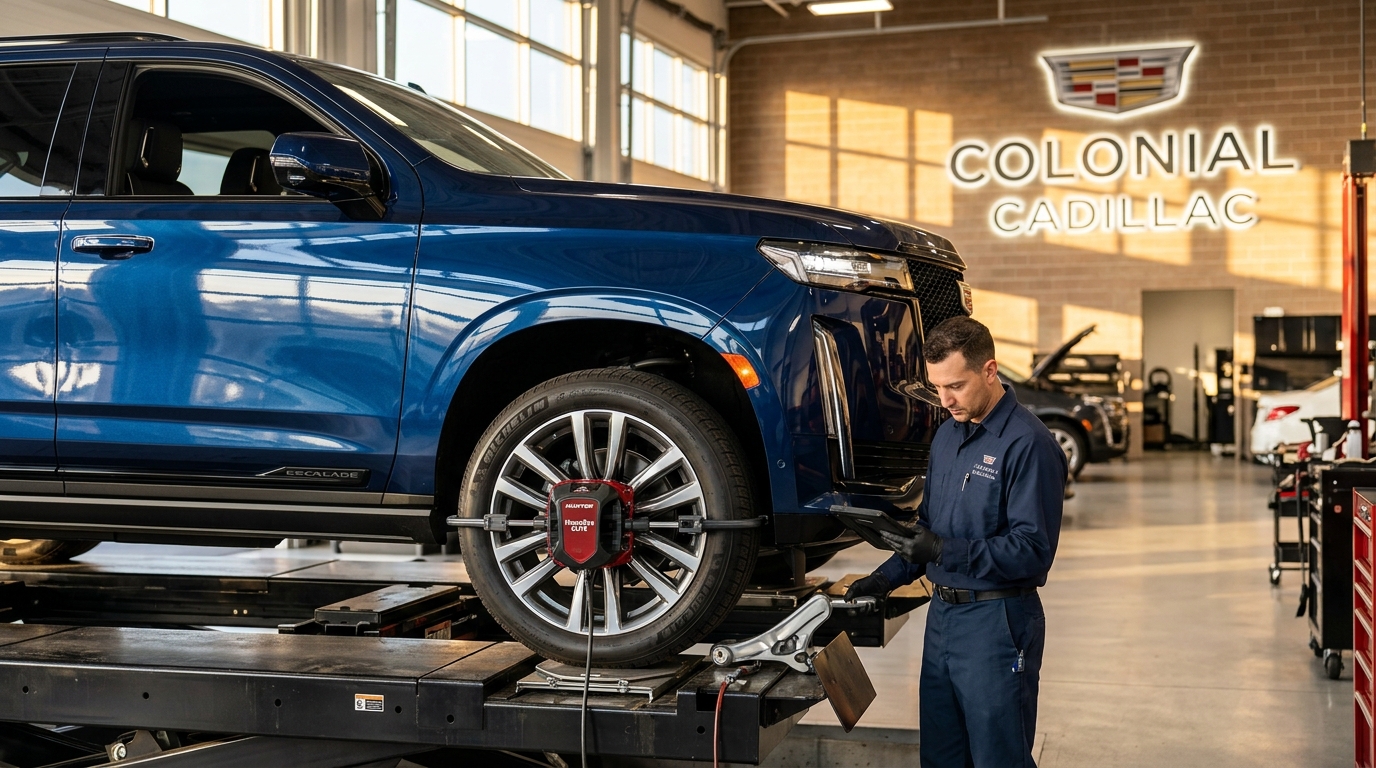
A 2026 Cadillac should undergo a wheel alignment check at least once every 12 months or between 12,000 and 15,000 miles under standard driving conditions. Vehicles should also be aligned immediately following a new tire installation, after any steering or suspension component replacement, or following a direct impact with severe road hazards like deep frost heaves and potholes.
Maintaining precise wheel alignment is essential for preserving the quiet ride quality, responsive handling, and tread longevity designed into every modern Cadillac chassis. Alignment settings describe the precise angles at which your vehicle’s wheels are mounted relative to the frame and the road surface. Over time, routine daily impacts—such as negotiating harsh road joints, striking curbs, or navigating broken pavement—slowly knock these settings out of factory tolerance.
Many luxury vehicle owners coordinate alignment inspections alongside their standard 7,500-mile oil change and tire rotation schedules. Rotating tires every 7,500 miles helps distribute tread wear evenly, while periodic alignment verifications ensure the tire’s contact patch meets the road at its ideal profile. When alignment angles drift even slightly, tires begin to scrub across the road surface rather than rolling cleanly, creating uneven tread patterns and prematurely shortening tire life.
Drivers commuting daily from Belmont down into high-traffic urban corridors experience significant suspension stress from varied road conditions and rolling terrain. Commuters who regularly navigate these challenging surfaces often benefit from having their alignment checked every 6,000 to 10,000 miles to keep the steering system aligned to original factory parameters.
To check your vehicle’s current tracking status or discuss recurring maintenance schedules, you can reach our service team by giving us a quick call or visiting our service center on Cambridge Road for a quick digital alignment check.
Table of Contents
- What Are the Primary Signs That Your Cadillac Needs an Immediate Alignment?
- Why Do Modern Cadillac Models and EVs Require a Four-Wheel Alignment?
- What Is the Price Difference Between Front-End and Four-Wheel Alignment?
- What Should a Complete Cadillac Suspension Inspection Include with Service?
- Do Independent Shops Have the Technology to Align Cadillac EVs?
- Quick Answers About Cadillac Alignment and Suspension Maintenance
- Keeping Your Chassis Operating at Peak Performance
What Are the Primary Signs That Your Cadillac Needs an Immediate Alignment?
The primary warning signs that a Cadillac requires an immediate wheel alignment include the vehicle pulling or drifting to one side while driving on a level road, an off-center steering wheel when traveling straight, persistent steering wheel vibration, and rapid or uneven tire tread wear. Promptly addressing these early indicators prevents minor mechanical drift from developing into costly tire replacement needs or suspension damage.
- Vehicle Drift or Pulling: If your vehicle consistently veers toward the left or right when you relax your grip on the steering wheel on a straight highway stretch, the chassis geometry has drifted away from neutral balance.
- Off-Center Steering Wheel: When driving straight ahead on a flat, level surface, the center crest on your steering wheel should sit perfectly horizontal. An emblem that cants off-center indicates that the front or rear toe alignment needs physical correction.
- Uneven Tread Wear Patterns: Inspecting your tire treads can reveal misalignment immediately. Feathering (where tread blocks feel smooth when rubbed one way but rough the other) or heavy wear concentrated exclusively on the inner or outer shoulder signals incorrect camber or toe settings.
- Steering Wheel Vibration: Slight oscillation or feedback felt through the rim during acceleration or cruising often points to misalignment coupled with front tire imbalance.
Ignoring early mechanical signs allows severe tread cupping to develop, which introduces cabin noise and compromises wet-weather traction. Furthermore, driver assistance safety features like Super Cruise rely heavily on steering angle position feedback. When physical alignment shifts out of tolerance, automated lane-centering software must continuously compensate against steering pull, which can trigger system warnings or disable hands-free functionality until recalibrated.
Why Do Modern Cadillac Models and EVs Require a Four-Wheel Alignment?
Modern Cadillac sedans, crossovers, and electric vehicles require a comprehensive four-wheel alignment because they utilize multi-link independent rear suspensions and intelligent all-wheel-drive systems that require front and rear tire tracking to stay perfectly synchronized. Unlike older front-wheel-drive vehicles that relied on a fixed rear beam axle, modern chassis designs feature fully adjustable suspension linkages at all four corners.
A proper four-wheel alignment verifies that all four tires form a true rectangle relative to the vehicle’s centerline, ensuring the rear wheels track directly in line with the front wheels (thrust angle). If the rear thrust angle shifts, the rear axle pushes the tail of the vehicle slightly off-center. This forces the driver to hold the steering wheel crooked just to keep the car traveling straight—a condition commonly known as dog-tracking.
Electric vehicles present unique chassis demands due to their heavy battery architecture and instant electric torque. The added curb mass places elevated vertical load on control arm bushings and ball joints, while rapid torque application puts continuous rotational stress on rear suspension links. Consequently, alignment tolerances on luxury EVs require strict precision to maintain stable high-speed tracking and minimize rolling resistance.
Advanced active chassis technology also demands complete four-wheel calibration:
- Magnetic Ride Control: Adaptive dampers alter damping fluid viscosity milliseconds at a time based on wheel position sensors. Precise baseline geometry ensures shock absorber travel matches system software calculations.
- Four-Wheel Steering Systems: Models equipped with active rear-wheel steering rely on exact mechanical alignment before electronic calibration resets the rear steering actuators.
- Electric Power Steering (EPS): Electronic steering racks continuously compute returning force and torque feedback based on factory caster and toe baselines.
What Is the Price Difference Between Front-End and Four-Wheel Alignment?
A basic two-wheel front-end alignment typically ranges from $50 to $75, whereas a comprehensive four-wheel alignment for a luxury vehicle usually costs between $100 and $230. The higher investment for a four-wheel alignment reflects the additional labor, precision computerized alignment technology, and electronic sensor resets required for modern independent rear suspension systems.
| Alignment Service Type | Typical Cost Range | Included Mechanical Focus |
|---|---|---|
| Front-End Alignment (2-Wheel) | $50 – $75 | Adjusts front camber, caster, and toe angles only; limited to rigid rear axle designs. |
| Four-Wheel Alignment | $100 – $230 | Adjusts all four wheels to original thrust line; recalibrates digital steering angle sensors. |
Front-end alignments adjust steering linkages on the front axle exclusively. While suitable for simple trucks or entry-level commuter cars with solid rear axles, two-wheel alignments are incomplete for modern luxury vehicles. Attempting a two-wheel alignment on a multi-link rear suspension leaves the rear thrust angle uncorrected, leading to premature inner-edge tire wear and persistent steering pull regardless of front-end adjustments.
A four-wheel alignment involves attaching high-definition optical targets to each wheel rim, measuring all geometric angles against factory specifications, and physically adjusting lower control arms, eccentric bolts, and tie rods. Additionally, modern four-wheel alignment service includes an electronic steering angle sensor (SAS) reset using specialized service software to keep safety systems working in harmony with physical suspension adjustments.
What Should a Complete Cadillac Suspension Inspection Include with Service?
A complete Cadillac suspension inspection performed alongside an alignment service must examine all structural hardware, rubber bushings, hydraulic dampers, and steering linkages for wear or damage. Attempting to align a vehicle with worn or compromised suspension components is ineffective, as play in ball joints or bushings allows alignment angles to shift as soon as the vehicle moves under its own weight.
During a professional multi-point suspension check, factory-trained technicians systematically evaluate the following vital components:
- Control Arm Bushings & Ball Joints: Technicians check for cracked rubber, fluid leaks on hydraulic bushings, and excessive mechanical play in ball joints that support wheel spindle movement.
- Tie Rod Ends & Steering Gear: Inner and outer tie rods are tested for movement to ensure steering input directly alters wheel angle without sloppy feedback.
- Struts, Shocks, and Springs: Inspects hydraulic dampers for oil leaks and checks coil springs for fatigue or sagging, which alters baseline camber and caster angles.
- Sway Bar Links & Bushings: Verifies that anti-roll bar connections are firm to minimize excess body roll during cornering.
- Wheel Bearings & Mounting Hardware: Checks hub assemblies for lateral play or grinding noise that could compromise tracking stability.
Combining a detailed mechanical assessment with periodic wheel alignment ensures that subtle component wear is caught before it leads to uneven tire wear or secondary steering component stress. Drivers planning seasonal routine maintenance can utilize our online service scheduling tool to select a convenient appointment time, and explore current service and parts specials prior to their arrival.
Do Independent Shops Have the Technology to Align Cadillac EVs?
While many independent repair facilities possess standard wheel alignment equipment, aligning modern Cadillac electric vehicles often requires advanced high-capacity lifts, EV-specific frame reference data, and factory calibration tools that generic shops may not maintain. Electric luxury vehicles feature dense underbody battery structures and sophisticated driver-assist sensors that require specialized care.
When servicing an electric vehicle, alignment racks must be rated for elevated curb weights and feature long ramp profiles that accommodate wide wheelbases without risking contact with low-slung battery shields. Furthermore, technician safety training is critical when working around high-voltage chassis components mounted adjacent to rear suspension adjustment points.
The primary limitation faced by third-party facilities involves recalibrating electronic driver-assistance hardware following mechanical alignment adjustments:
- Steering Angle Sensor (SAS) Recalibration: Mechanical changes to front toe shift the physical zero point of the steering wheel, requiring an electronic reset of the steering rack software.
- ADAS Camera and Radar Realignment: Adjusting the rear thrust angle changes the physical path the car follows down the road. Forward-facing cameras and radar modules must be calibrated relative to this new thrust line.
- Chassis Leveling Systems: Air suspension and active damper systems must be locked into service mode using specialized software before measuring alignment angles.
Drivers navigating urban road surfaces and winter-damaged pavement around Boston subject their vehicle chassis to significant road impacts. Ensuring that your vehicle is serviced using factory alignment software and OEM-approved calibration targets guarantees that all active safety and lane-centering features operate exactly as designed.
Quick Answers About Cadillac Alignment and Suspension Maintenance
Q: How does misaligned steering affect Cadillac Super Cruise?
Misalignment introduces subtle steering pull, forcing automated driving systems to work continuously against mechanical drift. When the steering angle sensor detects that physical vehicle travel does not match calculated steering inputs, Super Cruise may disengage or restrict availability until a full four-wheel alignment and sensor calibration are performed.
Q: Is a wheel alignment necessary every time I buy new tires?
While not strictly mandatory, performing a four-wheel alignment with every new tire installation is strongly recommended to protect your tire investment. Installing fresh rubber onto a vehicle with shifted toe or camber angles causes immediate, uneven tread scrubbing that permanently degrades tire performance and voids treadwear warranties.
Q: How long does a four-wheel alignment service take to complete?
A standard four-wheel alignment service usually takes between 60 and 90 minutes. This timeframe includes a pre-alignment test drive, a full multi-point suspension inspection, digital angle measurement, physical mechanical adjustments at all four wheels, steering angle sensor zero-point recalibration, and a final quality verification drive.
Q: What is the main difference between tire balancing and wheel alignment?
Tire balancing corrects heavy spots in the rotating tire-and-wheel assembly by adding small weights to the rim, eliminating high-speed steering wheel shimmy. Wheel alignment adjusts the mechanical angles of the suspension system relative to the chassis and road, ensuring even tread wear and straight-line tracking.
Q: Will driving over road hazards frequently ruin my vehicle’s alignment?
Yes, striking deep frost heaves, sharp pavement drops, or curb edges exerts severe force on suspension arms and tie rod threads. Over time, these sudden impacts alter factory camber and toe settings, making periodic alignment verifications essential for drivers who regularly travel on rough road surfaces.
Keeping Your Chassis Operating at Peak Performance
Maintaining correct alignment angles protects your tires, optimizes power delivery, and preserves the refined handling performance expected of a modern Cadillac. Regularly scheduling suspension inspections alongside routine tire rotations ensures that minor alignment shifts are corrected long before they impair driver assistance systems or cause premature tire wear.
When you notice your vehicle pulling to one side or observe uneven tread wear across your tires, our certified service team is ready to restore your vehicle to factory specifications. To arrange your next alignment check, contact our service team by giving us a quick call or getting directions to Colonial Cadillac of Woburn today.
© 2026 Colonial Cadillac of Woburn. All rights reserved.
Connect with us