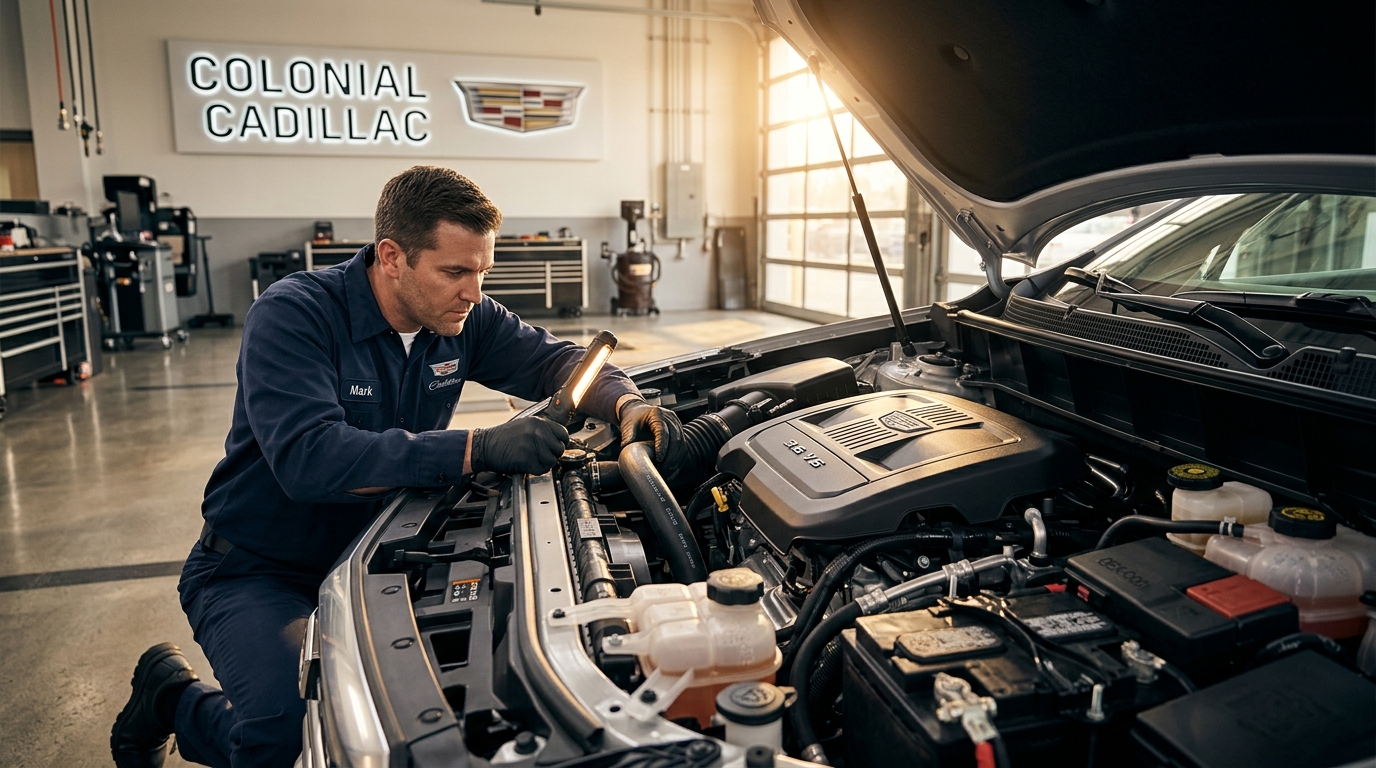
2026 Cadillac factory scheduled maintenance operates on an algorithm-driven service schedule anchored by the On-Board Engine Oil Life Monitoring System and mileage checkpoints starting at 7,500 miles or 12 months. Maintenance routines combine periodic fluid evaluations, tire rotations, cabin and engine air filter replacements, and multi-point safety inspections. Services escalate at 15,000-mile, 22,500-mile, 30,000-mile, and 45,000-mile intervals to keep internal combustion and electric powertrains performing to GM engineering standards.
Modern Cadillac engineering relies on real-time vehicle telematics rather than static calendar assumptions. The Engine Oil Life System evaluates operating temperatures, engine revolutions, idle duration, and ambient atmospheric conditions to calculate exact oil breakdown. When the Driver Information Center displays a service alert, scheduling maintenance within 600 miles protects key internal engine components. For models like the 2026 Cadillac XT5 equipped with the 2.0L Turbo engine or available 3.6L V6, maintaining clean dexos1 full synthetic oil safeguards turbocharger bearings and direct-injection fuel rails against heat degradation.
Regional driving environments directly influence vehicle component wear. Potholes, sudden freeze-thaw cycles, and heavy road salt application during winter driving around Boston create structural stress on steering linkages, lower ball joints, and alloy wheels. Factory scheduled service accounts for these severe driving factors through structured Multi-Point Vehicle Inspections that check suspension bushings, brake pad thickness, and undercarriage corrosion protection before minor surface wear develops into major mechanical damage.
Maintaining an active scheduled maintenance log protects vehicle resale valuation and keeps factory warranty protections intact. Owners can confirm service intervals or review upcoming milestone requirements by contacting our service team directly at (781) 935-7000 or visiting our Woburn service center facility.
Table of Contents
- What Is Included in Cadillac’s Recommended Factory Scheduled Maintenance?
- Does Cadillac Premium Care Maintenance Cover Air Filter Replacements?
- Can You Look Up Exact Cadillac Service Intervals by VIN?
- Do Cadillac Service Centers Charge Lower Labor Rates Than European Luxury Dealers?
- Should You Service Your Cadillac at a Dealer or an Independent Shop?
- Quick Answers Before Scheduling Your Cadillac Service
What Is Included in Cadillac’s Recommended Factory Scheduled Maintenance?
Cadillac’s recommended factory scheduled maintenance includes routine dexos1 full synthetic oil and filter changes, 7,500-mile tire rotations, Multi-Point Vehicle Inspections, passenger cabin air filter replacements, engine intake air cleaner element changes, and comprehensive hydraulic fluid checks. As vehicles accrue higher mileage, factory service expands to cover automatic transmission fluid flushes, transfer case service, spark plug replacements, and engine coolant flushes.
Factory maintenance visits follow a progressive milestone structure designed to address specific component degradation lifecycles:
- 7,500 Miles / 12 Months: Engine oil and filter exchange using dexos1 full synthetic oil, four-wheel tire rotation to balance tread wear across drive axles, top-off of washer fluid and engine coolant, and a Multi-Point Vehicle Inspection covering brake pads, rotor surfaces, battery health, and tire pressure sensors.
- 22,500 & 30,000 Miles: Replacement of the passenger compartment cabin air filter, inspection or replacement of the engine air cleaner element, testing of hydraulic brake fluid moisture content, and lubrication of front suspension wiper seals and body door hinges.
- 45,000 to 60,000 Miles: Fluid exchange for 9-speed automatic transmission and 10-speed automatic transmission assemblies operating under heavy load or severe city driving, transfer case gear oil replacement on all-wheel drive configurations, and iridium spark plug replacements on select high-output engines.
- 100,000 to 150,000 Miles: Inspection of engine accessory drive belts and a complete drain and refill of the engine DEX-COOL cooling system loops.
Powertrain architecture determines specific service requirements. Traditional internal combustion models like the 2026 Cadillac XT5, featuring 21 city / 27 hwy fuel economy ratings and 30 cubic feet of rear cargo space, require regular fluid maintenance to support direct-injection fuel systems and all-wheel drive transfer cases. In contrast, electric models like the Cadillac Lyriq bypass engine oil, exhaust systems, fuel filters, and spark plugs entirely, focusing routine upkeep on chassis lubrication, brake fluid testing, cabin filtration, and tire rotations.
Does Cadillac Premium Care Maintenance Cover Air Filter Replacements?
Standard Cadillac Premium Care Maintenance does not cover routine engine or cabin air filter replacements on most model years, as initial coverage focuses on complimentary initial oil changes, tire rotations, and multi-point inspections. Air filter replacements are scheduled maintenance items performed at specified mileage intervals—typically every 22,500 miles for cabin filters and 30,000 miles for engine air filters—and are billed separately or covered through extended protection plans.
Cabin air filters trap road dust, environmental soot, and airborne allergens before outdoor air enters the heating and air conditioning system. Commuters navigating green suburban corridors around Belmont face elevated seasonal pollen from nearby conservation areas, making periodic cabin air filter replacements essential for maintaining HVAC blower motor efficiency and interior air purity. Neglecting a saturated cabin filter restricts airflow across the evaporator core, which increases strain on the climate control compressor and leads to musty cabin odors.
Engine air intake filters serve a critical protective role for engine performance. Trapping abrasive grit prevents microscopic debris from entering combustion chambers, where particulate matter can score cylinder walls or damage turbocharger compressor wheels on models like the Cadillac XT5. Vehicle owners can schedule filter replacements and multi-point checks through our online service scheduling portal to ensure intake systems remain clean.
Can You Look Up Exact Cadillac Service Intervals by VIN?
Yes, you can look up exact Cadillac service intervals by Vehicle Identification Number (VIN) using the official digital Cadillac Owner Center portal, the myCadillac mobile app, or a dealership service database. Entering your 17-digit VIN yields a model-specific service matrix that accounts for your vehicle’s specific engine, drivetrain, and factory option packages.
A VIN-based lookup eliminates confusion caused by generic maintenance charts that group distinct engine configurations together. For example, a VIN query identifies whether a 2026 Cadillac XT5 carries the standard 2.0L Turbo engine or the available 3.6L V6, or whether a full-size SUV contains a gas engine or a turbo-diesel powertrain. Each powertrain configuration uses specific fluid capacities, oil viscosity ratings, and spark plug replacement schedules.
The VIN lookup tool cross-references active vehicle mileage against factory technical service bulletins (TSBs), software updates, and recall campaigns. When our certified service team accesses GM Global Warranty and Service Information system records using a VIN, we verify whether a vehicle requires specific transmission control module updates or differential fluid checks. Vehicle owners looking to plan routine service visits can check our current service and parts specials for seasonal maintenance offers.
Do Cadillac Service Centers Charge Lower Labor Rates Than European Luxury Dealers?
Cadillac dealership service departments in New England generally maintain lower labor rates than specialized European luxury service centers, offering average savings between $15 and $35 per hour. This labor rate advantage, combined with standardized factory flat-rate timing and competitive OEM component pricing, lowers total cost of ownership over the lifespan of the vehicle.
Luxury import vehicles from German manufacturers often require high hourly labor rates due to specialized diagnostic software subscriptions, imported replacement parts, and complex structural repair procedures. Cadillac engineering emphasizes accessible component layouts and standardized domestic parts networks. The resulting service efficiency allows factory-trained technicians to complete routine service tasks, such as brake pad installations or transmission fluid flushes, in fewer billable labor hours.
When local luxury owners transition from European imports to a Cadillac crossover, they frequently ask whether routine service requires specialized labor pricing; our technicians walk them through standard flat-rate labor structures that deliver noticeable savings on standard maintenance. Access to factory-direct tooling and direct software flashing guarantees diagnostic precision without the inflated labor overhead common at European import specialty shops.
Should You Service Your Cadillac at a Dealer or an Independent Shop?
Servicing your Cadillac at an authorized dealership guarantees model-specific maintenance performed by factory-trained technicians using Genuine GM OEM parts, specialized MDI 2 diagnostic equipment, and direct access to active software updates. While independent repair shops can perform basic oil changes, they lack direct factory telematics integration, proprietary calibration tools, and automatic warranty claim documentation.
Dealership service visits automatically log completed maintenance into the official General Motors Global Warranty Management database. This centralized service record proves compliance with factory maintenance standards, preserving coverage under the 4-year / 50,000-mile Bumper-to-Bumper Limited Warranty and 6-year / 70,000-mile Powertrain Limited Warranty. Furthermore, Genuine GM OEM parts installed at an authorized service center carry a 2-year / unlimited-mileage limited warranty on both parts and labor, providing repair protection that independent garages rarely match.
Quick Answers Before Scheduling Your Cadillac Service
Q: How often should the engine oil be changed in a 2026 Cadillac XT5?
Engine oil in a 2026 Cadillac XT5 should be changed every 7,500 miles or 12 months, guided by the on-board Engine Oil Life Monitoring System. The system tracks engine revolutions, running temperatures, and idle duration to notify the driver when service is required. Using factory-approved dexos1 full synthetic oil protects internal valve train components and turbocharger bearings.
Q: What is checked during a Cadillac Multi-Point Vehicle Inspection?
A Cadillac Multi-Point Vehicle Inspection evaluates critical safety and operational systems, including brake pad thickness, rotor surface condition, tire tread depth, tire pressure, battery cold-cranking capacity, steering linkages, suspension struts, fluid clarity, drive belts, exterior lighting, and windshield wiper blade wear.
Q: How does winter road salt impact Cadillac maintenance intervals around Boston?
Winter road salt and liquid chemical de-icers accelerate undercarriage corrosion and can cause brake slider pins to stick. Drivers in Medford who travel along Mystic River commuter corridors during freezing months benefit from annual spring underbody rinses, brake pin lubrication, and alignment checks to counteract pothole impact stress and road salt exposure.
Q: How often does the Cadillac DEX-COOL engine coolant need to be replaced?
Cadillac DEX-COOL engine coolant is formulated for replacement at 150,000 miles or 5 years, whichever comes first, under normal driving conditions. Periodic coolant level and freeze-point concentration checks during routine 7,500-mile service visits confirm system pressure integrity and corrosion protection.
Q: What maintenance is required for electric Cadillac models like the Lyriq?
Electric Cadillac models eliminate engine oil changes, spark plug replacements, fuel filter swaps, and transmission flushes. Required maintenance focuses on 7,500-mile tire rotations, cabin air filter replacements every 22,500 miles, hydraulic brake fluid testing every 5 years, and high-voltage battery cooling circuit flushes at designated 150,000-mile milestones.
To maintain your vehicle’s safety, efficiency, and resale value, trust your factory maintenance to our factory-trained service team. You can stop by our Woburn service center or speak directly with an advisor by giving us a call at (781) 935-7000 to set up your next service visit.
© 2026 Colonial Cadillac of Woburn. All rights reserved.
Connect with us